Updated September 2026.
There is exactly one guaranteed way to protect your truck from deer season. Leave it in the garage until January. It stays perfect. It also hauls nothing, tows nothing, and earns nothing.
For everyone who actually drives a truck in the fall, the picture looks like this. You cannot out-plan a deer. It stands in the ditch, picks the worst second of your week, and jumps. What you can do is have the truck ready before October. Ready is not a stick-on whistle. Ready is a steel front bumper built to take the hit and one driving rule that insurers repeat every fall.
A 12-minute read. In a hurry? The short version is right below.
The key takeaways for readers short on time. The evidence, the photos and the truck that fell 70 feet are in the full story below.
- Skip the deer whistles. Scientists have tested them, and the evidence they prevent anything is not there. The science
- If a deer appears: brake hard and stay in your lane. The swerve, not the animal, is what turns a strike into something far worse. The rule
- Risk peaks at dawn, dusk and after dark, October through December. Over 71% of deer crashes happen in those hours. The numbers
- When the hit cannot be avoided, what sits in front of your radiator decides the bill. That is where real steel earns its place. The steel
You cannot out-plan a deer. You can be ready for one.
See which steel fits your drivingThe Odds, Straight From the Claims Data
State Farm estimates more than 1.6 million animal collision claims in the year through June 2026, and deer remain by far the most struck animal. Averaged across the country, a US driver carries a 1 in 145 chance of an animal collision this year. In West Virginia it is 1 in 46.
November, October and December lead the year, in that order, in State Farm's own ranking. November alone files animal-strike claims at more than twice the yearly average rate, and HLDI, the insurance industry's loss-data shop, priced the difference too: the average November animal strike claim runs $4,997. Even February, the mildest month on the calendar, averages $3,854, more than any front bumper on this page. The fall deer is both more likely and more expensive, and the "cheap" season never gets cheaper than the steel.
It also happens exactly where trucks live. When Illinois DOT broke down the state's 14,522 deer crashes of 2021, over 72% were on rural roads and over 71% came at twilight or night.
The fall multiplier
Insurance claims data, not folklore.
Three months carry the season. Miss October and you ride the worst quarter of the year on factory plastic.
The Gadget Shelf, Tested by Actual Scientists
Walk any parts store in September and the deer aisle is waiting for you. Stick-on air whistles for a few dollars a pack. Electronic emitters that promise ultrasonic cover. The pitch never changes: air rushes through at speed, the sound warns the deer, the deer stays out of your lane.
Researchers have checked. The University of Georgia ran the most direct field test on record, published in the Journal of Wildlife Management: they drove at free-ranging whitetail deer while playing the pure tones whistles produce, inside the range deer actually hear. Deer behavior did not change. The one low tone that drew any reaction at all moved deer toward the roadway, not away from it.
The sound itself does not even survive the trip. A 2003 lab test, one of the studies collected in Iowa State's engineering review, measured what the whistles really emit and found they pitch far lower than the packaging claims. At 40 mph, the researchers wrote, the lower tone was totally lost inside the vehicle's own road noise. Your truck out-shouts the whistle bolted to it. The same review adds the line worth remembering: for electronic deterrent devices, its reviewers found no independent studies at all.
Will a whistle scare some deer, on some night, somewhere? Nobody has ever been able to show it. That is the whole problem. You are not buying protection, you are buying a coin flip, and the stake on the table is your radiator.
⚡ The bet, in plain numbers
A pack of whistles costs less than lunch, and no study has ever shown one changes a deer's mind. The average November animal-strike claim runs $4,997. Do not put a 4-figure front end on a sticker that loses to road noise at 40 mph.
The One Rule That Saves Lives
Before any steel goes on, learn the rule that insurers and state DOTs repeat every fall. It decides more than your bumper does.
Do not swerve. Brake hard and stay in your lane. State Farm and Illinois DOT print the same instruction almost word for word: brake firmly, hold your lane, and if the hit is coming anyway, glance off the deer rather than trade it for the oncoming lane or the ditch.
The reason sits in the fatality data. In 2024, 210 people died in US crashes involving animals, by the count of IIHS, the insurers' crash-research institute. In 37% of those deaths the deadliest part was not the animal. It was what came next: the rollover, the tree, the oncoming lane.
Plenty of risks are cheap. Skip the gym, forget the hat, run late. Nothing follows you home. This one is not that kind. In that cab it is you, the person your family runs on, and on plenty of nights it is them riding behind you. 210 is not a big number, and it does not need to be. The job is to keep you and yours off that list entirely.
Steel does not change the rule. It changes what is on the table when you obey it.
⚡ The skill you take from this page
Brake firmly. Stay in your lane. In 37% of the deaths in animal crashes, the deadliest part was not the animal but what came next: the rollover, the tree, the oncoming lane. Insurers and state DOTs give the same instruction because the data gives them no other.
Your Factory Front End Was Never Built for This
The federal bumper standard, 49 CFR Part 581, applies to passenger cars. Pickup trucks are not covered by it at all. Even for the cars it does cover, the standard tests a 2.5 mph impact. Not 55. No law requires your truck's factory front end to survive anything.
On most late-model trucks the nose is a painted plastic skin, foam and a thin formed bar. Even where the factory bumper is steel, the grille, the radiator, the AC condenser and both headlight assemblies sit exposed right above it. A deer at highway speed collapses that package straight into the hardware behind it.
The bills prove it. CCC, the company that processes collision estimates for US body shops, puts the average US collision repair, across all causes, at $4,768 through the third quarter of 2025, right in the range the insurers' animal-claim numbers occupy. Truck forums post the receipts: $6,000 on a stock Tacoma, roughly $10,000 when the radiator went into the engine, $18,200 for one interstate deer at 70 mph. Parts alone hurt. Ford's dealer catalog prices a 2023 F150 front bumper assembly at $2,759.53 before anyone paints or installs it. What that bill looks like line by line, and what the same money buys in steel, is in our front bumper replacement cost post.
What Actually Stops the Hit: A Steel Front Bumper
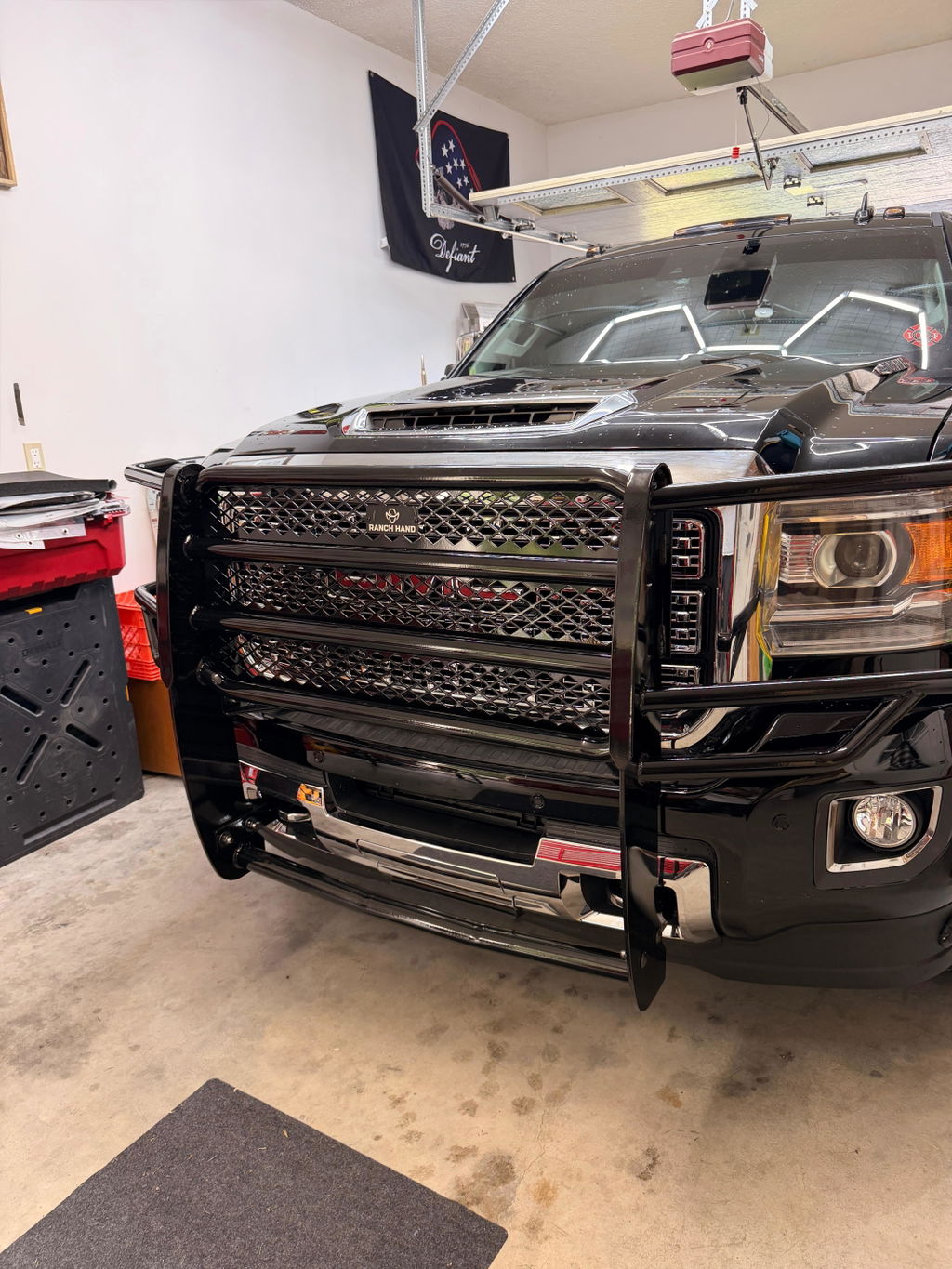
Once avoidance fails, protection is physical. And on a truck, one part is built for exactly this job: a front bumper with a full grille guard. It replaces the factory bumper entirely. One welded steel unit takes over the whole nose, frame to headlights: tubing uprights, punched-plate inserts, and a bumper body of diamond plate or schedule 40 pipe, the same steel pipe spec you see in pipelines and handrails. There is no factory plastic left in the fight. Anywhere on the nose, frame rails to headlights, the hit lands on one piece of steel and runs down into the frame. Across Steelcraft and Ranch Hand, these run $1,659 to $2,073 on our shelf right now.

What about a bolt-on guard over the factory bumper? It shields the grille and the headlights, and that is worth something. But the hit itself still lands on the factory bumper below it, and you already read what that bumper is required to survive: nothing. Shielding the top half of the nose is not the job. Replacing the front bumper is.
Every front bumper we name in this post is frame-mounted steel. Which one belongs on your truck comes down to the road you drive, and that call sits 2 minutes down the page.
3 front ends, 3 outcomes
Front-to-back, what the deer meets first.
Every level up moves the first point of contact from your truck's plumbing to plate steel.
Evidence From the Road
Nobody crash-tests grille guards into deer surrogates in a US lab. That test does not exist, and we will not pretend otherwise. What exists is 20 years of owners writing down what happened to their own trucks. The threads are public, on Ford Tremor, TacomaWorld and the other owner forums; search the truck, the speed and the word deer, and they come up.
| The truck and the steel | The hit | What broke |
|---|---|---|
| Half-ton Chevy, add-on steel guard | Deer at 60 mph | Guard pressed into the hood edge, truck kept driving |
| Police Dodge Charger, front guard | Doe at 55 mph | Guard flexed into the fender, one liner replaced |
| 2007 Tacoma, steel front bumper | 3 deer over the years, up to 40 mph | Nothing, each deer went down and under |
| 2006 Tacoma, steel front bumper | Full-size doe at 45 mph | Cracked fog light trim, bent license plate |
| 2nd-gen Tacoma, steel front bumper | 2 deer in 7 months | A scrape in the powder coat |
| Stock 2017 Tacoma | Deer at 55 mph | Radiator into the engine, roughly $10,000 |
| Stock 2018 Tacoma | One deer | $6,000 and weeks in the shop |
The loudest single data point sat on Ranch Hand's own SEMA booth, and it is not even a deer. In 2018 a Ranch Hand customer's 2008 Silverado 2500HD blew a front tire on an overpass and went over the side, a fall of about 70 feet. The truck landed on the upright bars of its Ranch Hand Legend front bumper. The frame twisted and the truck was done, but the driver climbed out through the sunroof with minor scratches, and Ranch Hand parked the wreck at the SEMA show that year as the exhibit. The plaque on the display carried the owner's own words: "The whole motor would've crushed my legs if I did not have that Ranch Hand on there." A deer is not a 70 foot fall. That is the point.


Photos: Off Road Xtreme's SEMA 2018 coverage of the Ranch Hand display.
Ranch Hand itself promises nothing wild: construction specs and one slogan, Built to Take a Hit. The big deer claims come from its customers, on the brand's own testimonial wall: a 65 mph strike reported with not even the tiniest bit of damage, and one owner counting a $15,000 repair that became $1,500. Steel does not promise you a clean walk-away. It loads the odds your way, hit after hit.
Why I Am Writing This
You could read all of this and shrug. Deer happen to other people. And a bumper store telling you a bumper is the answer is easy to wave off.
So let me drop the retailer voice for a minute. I have a family, and they ride behind that front end. For me this was never a whistle-versus-steel debate. It was one question: do I want to find out the hard way? I closed it once, with steel, and I have not thought about it in November traffic since.
Go back to that fatality number for a second. 210 is not a statistic to me. It is 210 people who had plans for the weekend and families waiting on dinner. And every driver inside those 1.6 million claims was sure it would not be them. That is how this works. Nobody plans the deer.
Now here is what I believe happens in the half second that decides everything. No study measures this, so take it as one truck owner's read. The driver with a factory front end sees the deer, and his brain prices the hit before his hands move: my truck, the repair, the money. So the hands pull the wheel, and the ditch or the oncoming lane does the rest. The driver with steel up front has nothing to price. He knows the truck is ready, so braking straight costs him nothing, and the safe move comes easier. The rule saves lives. Steel makes the rule easier to obey.
This post is not me selling you a front bumper. It is the case I would lay out for my own brother before October: the numbers, the science, the one driving rule, and the honest price of being wrong. If it makes even one reader brake straight instead of swerving, or bolt real protection on before the season opens, that is one truck and maybe one family that stays off the lists above. That is the honest reason this page exists. Better overprepared than underprepared. And prepared, in this exact fight, has one shape: a steel front bumper with your truck's name on it.
The Math Your Accountant Would Run
Deer hits fall under comprehensive insurance, the same bucket of your policy as theft and hail. IIHS spells that out directly. Your deductible does not disappear, though, and neither do the weeks while the shop waits on a radiator support and a headlight assembly. If the truck is how you earn, every one of those days has its own number on it.
Now load the other side of the scale. A front bumper with a full grille guard runs $1,659 to $2,073 on our shelf, once. It does not expire in January. It stands duty next deer season, and the one after that, on every February night and every June morning in between. That is the whole trade.
⚡ One purchase, priced against one claim
The average November animal-strike claim: $4,997, plus your deductible, plus the rental, plus the downtime. A Ranch Hand Summit front bumper for an HD Silverado: $1,744.95, once. It never comes off duty.
Which Steel Belongs on Your Truck
You commute through deer country at dawn and dusk. Your exposure is the radiator and the headlights, and your miles pile up in exactly the hours deer move. A front bumper with a full grille guard closes both ends of that problem, and half-tons carry the lighter builds fine: Steelcraft's Elevation front bumper starts at $1,659.
You run rural miles for a living. The truck cannot sit in a shop for weeks, so put the heaviest steel up front: a full-guard front bumper from Ranch Hand or Steelcraft. One welded unit, one hit path, straight into the frame.

You are building the truck out anyway. Winch-ready full-guard front bumpers exist across both lines, so the deer armor and the recovery gear share one piece of steel.
Two practical notes before you order. First, weight: these front bumpers run from about 165 to just over 300 lb, and our weight post measured what that does to a truck: the nose settles about 1/2 inch and fuel runs about $32 more a year. Real, and small. Second, sensors: on 2021 and newer trucks the parking sensors, camera and radar need a home in the new front end, and our sensor compatibility post breaks down who keeps what, line by line. These front bumpers ship by freight truck on a pallet, not in a parcel box; they bolt to existing frame points on nearly every application, and the swap is a half-day job for 2 people.
We ship steel front bumpers every business day, and the fitment data behind the listings comes from the supplier sheets we sell from, not from guesswork.
If a strike left your front end open or hanging, the next question is usually whether you can legally drive it like that. We pulled the state codes and wrote the answer down.
Frequently Asked Questions
Do deer whistles work? No study has ever shown they do. The University of Georgia field study found deer behavior did not change when vehicles approached playing whistle tones, and the one tone that drew a reaction pulled deer toward the road. Lab testing also found the whistles emit different frequencies than advertised, and the lower tone drowns in road noise at 40 mph. For electronic deterrents, reviewers found no independent studies at all.
Will a grille guard alone protect my truck from a deer? Partly. A bolt-on guard shields the grille and the headlights, and guarded front ends show up in owner reports far better than bare ones. But the hit itself still lands on the factory bumper underneath. The full answer is a front bumper with a full grille guard: one steel unit that replaces the factory bumper and takes the whole hit itself.
What should I do when a deer jumps out in front of my truck? Brake firmly and stay in your lane. That is the standing instruction from State Farm and from state transportation departments. Swerving trades the deer for the ditch, a tree or the oncoming lane. In more than a third of deaths in animal crashes, that aftermath, not the animal, was the deadliest part.
When are deer strikes most likely? October through December. State Farm ranks November first, then October, then December, and November alone files claims at more than twice the yearly average rate. Within the day, the risk stacks at twilight and night; Illinois measured over 71% of its deer crashes in those hours, and over 72% on rural roads.
Does insurance cover hitting a deer? Animal strikes fall under comprehensive coverage, the same part of your policy that handles theft and hail, not collision. You still pay your deductible, you still lose the truck to the shop for parts and repair time, and the claim sits on your record for years. The steel argument is not about replacing insurance. It is about keeping the claim from happening.
How much does hitting a deer cost to repair? The average November animal-strike claim runs $4,997 per HLDI, and the average US collision repair overall sits near $4,768. Forum reports run from $6,000 to $18,200 depending on speed. Even factory parts alone are steep: a 2023 F150 front bumper assembly lists at $2,759.53 before paint and labor.
Will a new front bumper keep my parking sensors working? On 2021 and newer trucks, check before you order. Some listings keep every sensor and the camera, some relocate them, and a few delete them. The listings state it, and if yours does not answer your exact truck, send us the year, cab and trim before you order and we will pull the supplier sheet and confirm.
Meet October Ready
Deer season is not a surprise. It arrives on schedule every fall, and this year your truck gets to meet it prepared. The steel front bumpers we verified for this post run $1,659 to $2,073 across Steelcraft and Ranch Hand. Send our fitment desk your year, cab and trim, and we will pull the exact listing that bolts to your truck and keeps your sensors alive, before a dollar moves.
One purchase, and the question stays closed for every season after. It rides out front in the cold, takes the hit you never saw coming, and asks for nothing back. Loyal like a good dog.