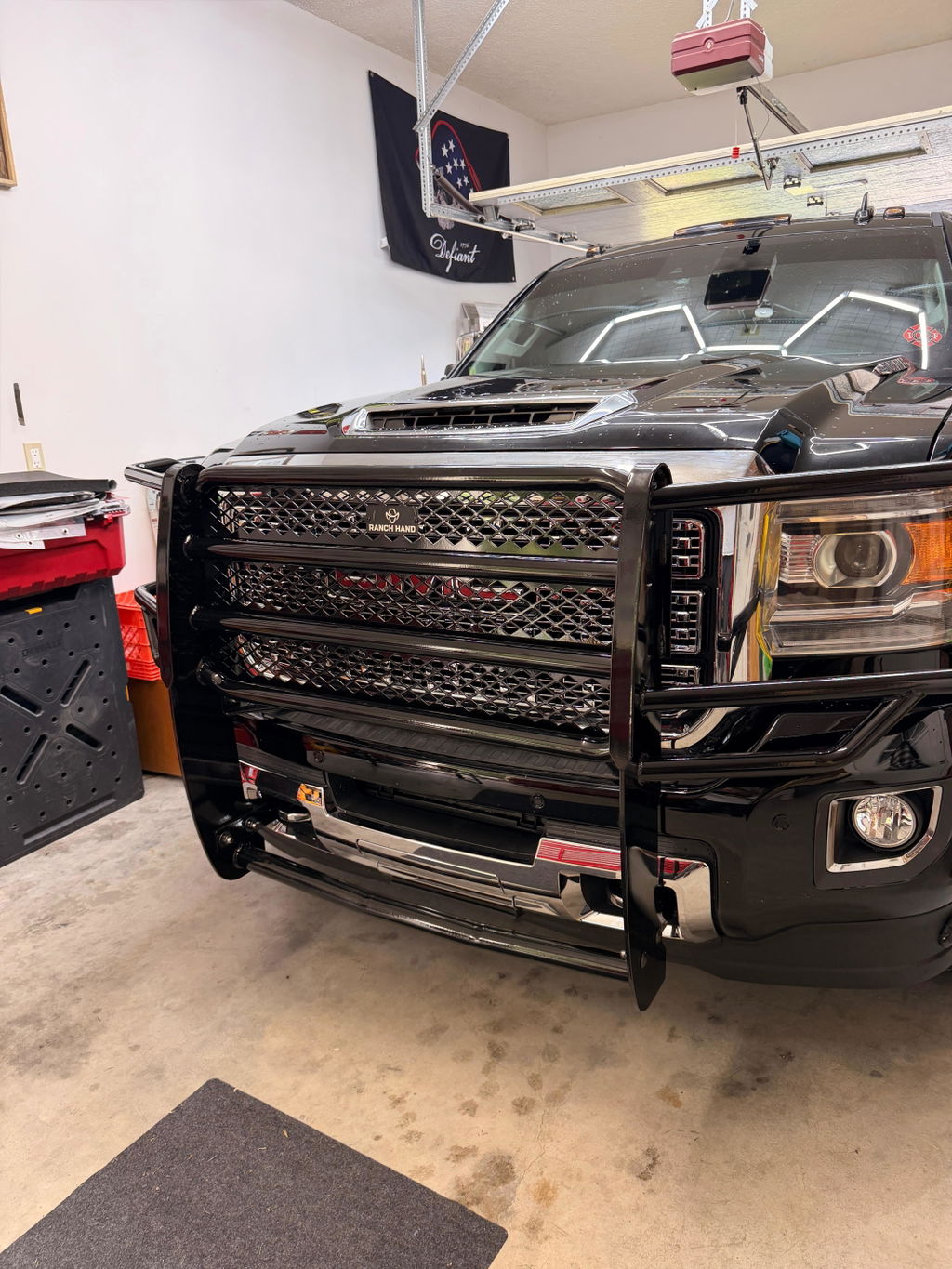
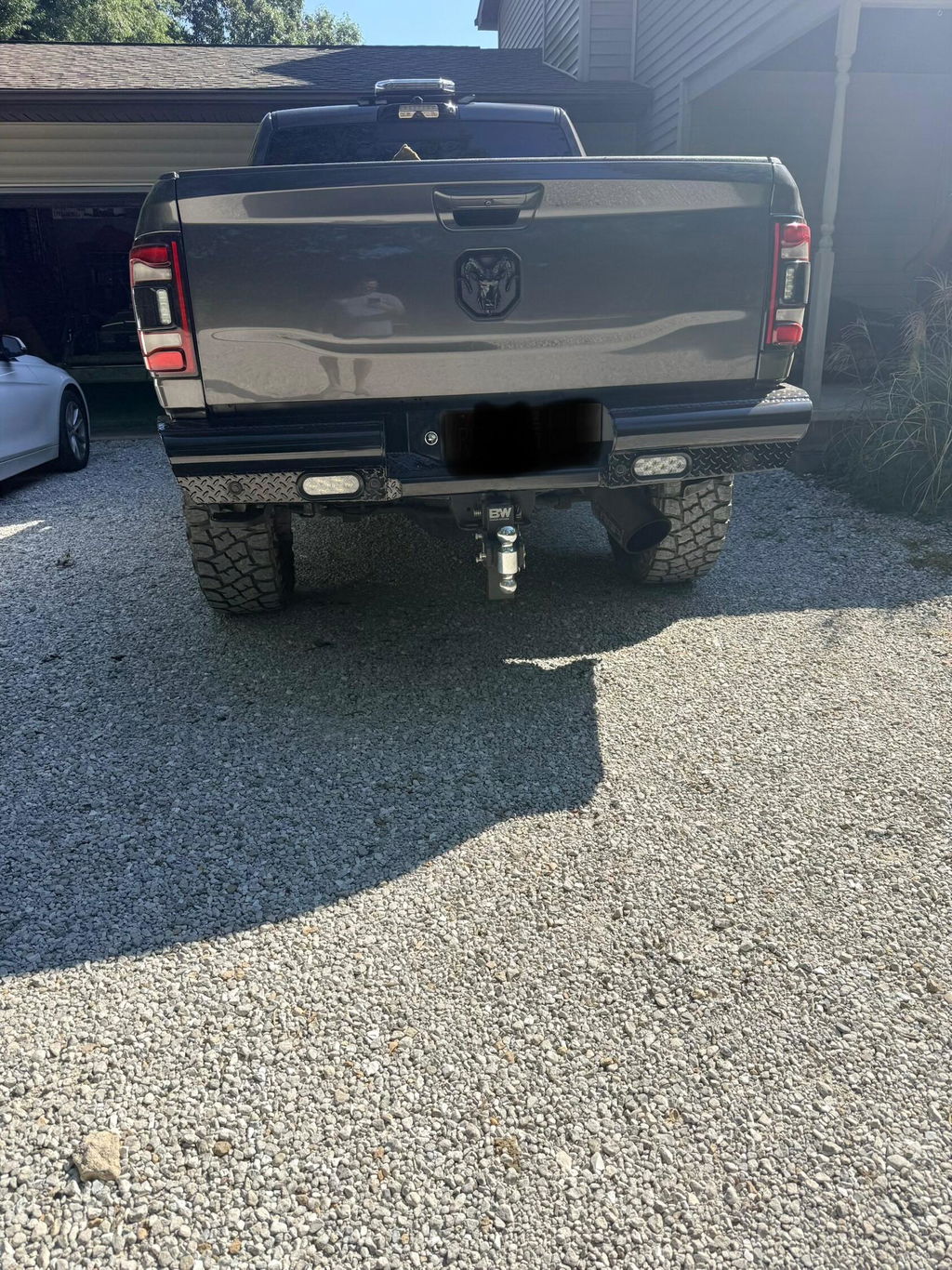
Updated August 2026.
We ship steel front bumpers every day, and this is the question that comes back more than any other. You are about to bolt a few hundred pounds of steel to the front of your truck. Will the truck care? Barely. It sits about 1/2 inch lower and costs about $32 a year in fuel. Here are the numbers and where they come from.
Start With What Ford Already Signed Off On
Look at what the factory itself is willing to hang off the nose of the same truck.
⚡ The number that ends the argument
Order a Super Duty with the Snow Plow Prep Package and Ford rates it for a 1,400 lb front plow. That is from Ford's own press release, it counts the mounting hardware, and it applies to gas 4x4 F250 and F350 trucks. Diesel is rated 1,290 lb.
A steel front bumper adds about 190 lb net. With a winch you are near 350 lb. A plow also mounts farther out front than a bumper does, so every pound of plow leans on the front end harder than every pound of bumper.
What Ford signs off on
Weight hanging ahead of the front axle, on the same truck.
Ford rates the Super Duty for 1,400 lb of plow on gas and 1,290 lb on diesel, mounting hardware included. A bumper and a winch together are about a quarter of that.
That is the short answer for a Super Duty. A half-ton has less room to spare, and its section is further down.
So How Much Weight Are You Really Adding?
The number gets inflated twice over, and almost nobody separates the two.
The crate. Shops publish shipping weight and call it weight. Ranch Hand prints both on its own page for the Summit front bumper for a Super Duty: 237 lb as an item, 288 lb as it ships. That 51 lb gap is crate, pallet and packing. The only part of it that stays on the truck is the hardware bag.
The bumper you take off. Your factory bumper is not free weight. Here are the actual bars, by part number, off the dealer parts catalogs. Those catalogs do not always say whether a figure is part weight or shipping weight, so treat these as close, not exact:
- Ford F150 2018-2019, part JL3Z-17757-A: 37 lb
- Chevy Silverado 1500 2019-2022, part 84588806: 24 lb
- Ram 1500 2019-2024, part 5ZB45GXHAA: 32 lb, plus a 9 lb reinforcement behind it
- Ford Super Duty 2011-2016, part BC3Z-17757-B: 52 lb
Add the brackets, end caps and valance, which is the trim panel under the bumper, and you are at roughly 40 to 55 lb on a half-ton and 60 to 70 lb on a 3/4-ton. The 70 and 75 lb numbers you see quoted are counting the full chrome assembly with the fog lights, the valance and the energy absorber behind it. That is a fair number for that whole assembly and the wrong one for the bar.
One thing worth knowing if you drive a newer F150. When Ford switched that truck to an aluminum body, the bumpers stayed steel. So your aluminum F150 carries the same steel bumper weight as the old one.
⚡ Do the subtraction
A 250 lb steel bumper, minus the 60 lb factory bumper that comes off a 3/4-ton, is a net gain of 190 lb on a truck that weighs 7,000 lb. On a half-ton both numbers are smaller.
The popular articles put the factory bumper at 70 to 75 lb without naming a single part. The part numbers above are what we counted instead.
The listing number is not what you add
A 3/4-ton truck, heavy end of the steel front bumper replacement range.
On a half-ton both numbers are smaller. And watch the listing weight itself: Ranch Hand prints the Summit front bumper at 237 lb as an item and 288 lb as it ships.
Weight also depends on what you buy. A bolt-on grille guard is the lightest way in, because it adds steel in front of the factory bumper instead of replacing it. A tube-style front bumper sits in the middle. A full steel replacement like the Ranch Hand Summit is 237 lb as an item. The math above uses 250 lb, the heavy end, so the real number on your truck is probably lower.
Will the Front End Sit Lower?
A little. Here is what owners measured on their own trucks, because a sag number with no truck attached tells you nothing.
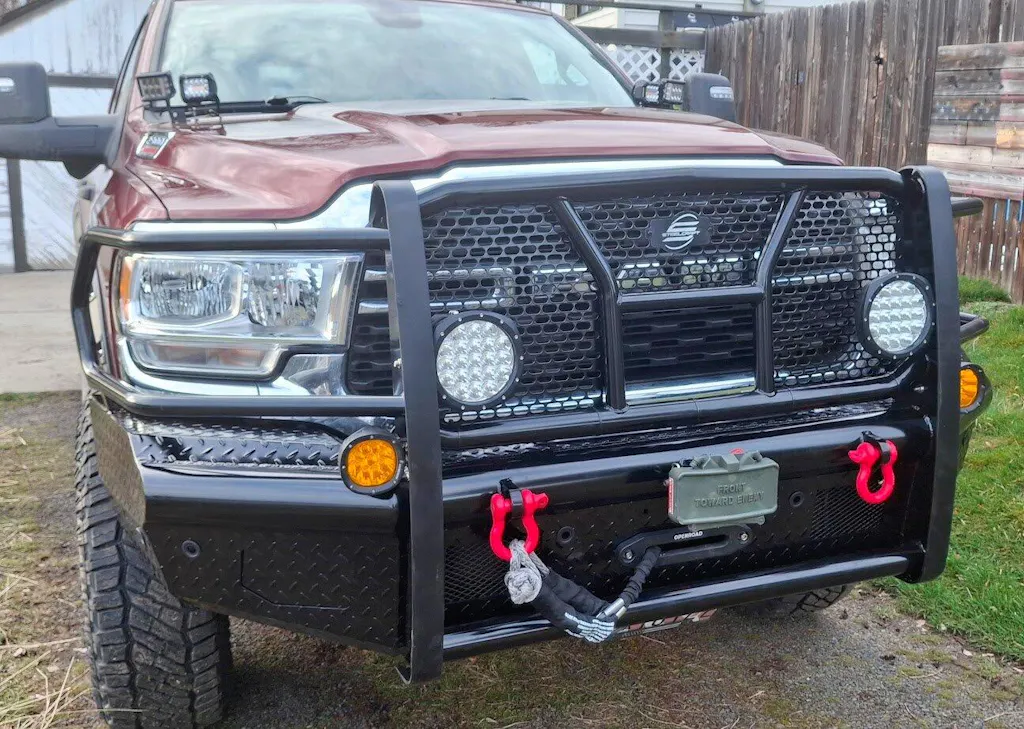
On the Ford Tremor forum, a 2023 F250 owner fitted a full Ranch Hand replacement front and measured 1/2 inch, before and after. On Powerstroke.org, a Super Duty owner running a bumper and a 12,000 lb winch said it "didn't even drop 1/2 inch." Across a dozen threads on Cummins Forum and HD Rams, the Ram 2500 and 3500 answers cluster at 1/4 to 1/2 inch. On GM-Trucks, a 2020 GMC Sierra 2500 AT4 owner with a Ranch Hand Legend said the truck "sits exactly the same and rides exactly the same."
Add a winch and the honest range is 1/2 to 1 inch.
How far the nose actually drops
Measured by the owners, not estimated.
| Truck | What was fitted | Measured drop |
|---|---|---|
| 2023 Ford F250 Tremor | Ranch Hand full replacement front | 1/2 inch |
| Ford Super Duty | Aftermarket bumper and a 12,000 lb winch | Under 1/2 inch |
| Ram 2500 and 3500 | Bumper, and bumper with winch, a dozen threads | 1/4 to 1/2 inch |
| 2020 GMC Sierra 2500 AT4 | Ranch Hand Legend | No change |
Springs keep settling for about a month, so day one is not the final number. And how far it drops depends on your springs more than on your bumper.
One honest note. Every measurement above is from a heavy duty truck, because that is where owners post numbers. A half-ton runs softer front springs, so expect the top of that range or a little past it, closer to 1/2 to 3/4 inch, and up to 1 inch with a winch. If you want the exact figure for your truck, measure fender lip to hub before and after.
If You Want It Dead Level Again
You do not have to do anything. 1/2 inch on a full-size truck is not something you see across a parking lot, and plenty of owners never touch the suspension.
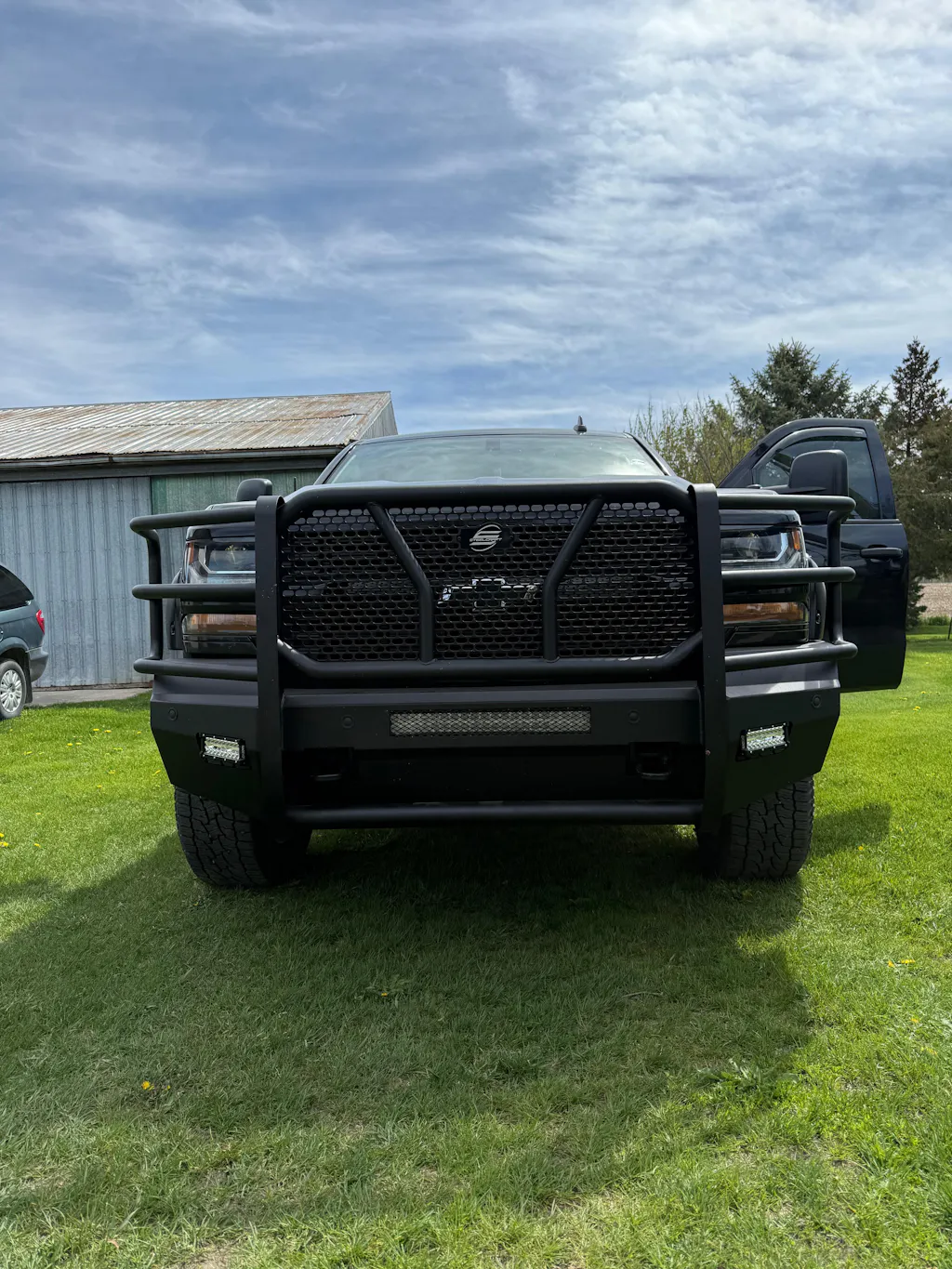
If you want the stance perfect, springs are the way to get it. One correction while you shop, because the usual internet advice is wrong. A spacer and a spring are not the same thing. Rancho says it plainly in its own technical guide: a spacer kit "doesn't change spring rate." Spring rate is how much weight it takes to squash the spring an inch. A spacer lifts the truck back up without adding any capacity underneath. Heavier front coils change the rate and carry the load.
That is a preference, not a repair.
Will It Wear Out Your Suspension?
Nothing we found says it does. This is the question our fitment desk gets most after fitment itself, and it is the one with the least behind it once you go looking.
⚡ 140,000 miles, still tight
A Ram owner running a full steel replacement bumper and a 12,000 lb winch reported 140,000 miles on his ball joints, on a truck with 250,000 miles on the clock. Still tight.
For scale, ball joints on these trucks usually last 75,000 to 120,000 miles with no bumper at all.
We went looking for the opposite story on Cummins Forum, Powerstroke.org, GM-Trucks and the Ram boards. Owners posted plenty of measurements. Nobody posted a failure they blamed on a bumper. The warnings we found were all predictions, while the long reports came with odometer readings and no failures. One truck is not proof. It is the only kind of evidence anyone has posted, and it points one way.
The engineering agrees. Your front axle has a published limit, the front GAWR, which is the most weight that axle is allowed to carry. It is on the compliance sticker in your driver's door jamb.
Now the part nobody mentions. A bumper hangs about 3 feet ahead of the front wheels on a 13-foot wheelbase, so the front axle picks up roughly 1.2 times what the bumper weighs, and the rear axle carries a little less. Call it 190 lb of bumper showing up as about 230 lb on the front axle.
On a heavy duty truck that limit sits well above what the front axle already carries, which is why owners do not run into it. If your half-ton already runs loaded, a truck stop scale weighs the front axle for a few dollars and settles it exactly.
Does It Cost You at the Pump?
Barely, and the usual number quoted for it is too high.
The Department of Energy prints the rule on fueleconomy.gov: "an extra 100 pounds in your vehicle could reduce your MPG by about 1%." The same page says the effect is smaller on larger vehicles, and that 1% is based on a car. Your truck weighs about twice a car, so we halved it. That is our arithmetic, not theirs, and it errs on the safe side.
⚡ About $30 a year
Run it on a real truck. 190 lb on a 7,000 lb pickup getting 18 mpg costs about 8 extra gallons over 15,000 miles. At $4 a gallon that is about $32 a year.
Less than one tank. Owners who report a bigger hit are usually running a tall tube guard, and that is the shape catching air rather than the weight.
What Should You Check Before Ordering?
One thing. If your truck is a 2021 or newer with adaptive cruise, a front camera or parking sensors, the radar and camera behind the factory bumper need a home in the new one. Some bumpers keep them, some relocate them, some have no place for them.
You can check this yourself in 2 minutes. On any bumper's product page, look for the sensor cutouts in the photos and the sensor line in the fitment notes. If it is not spelled out there, the supplier's fitment sheet has it.
So, Yes or No, by Truck
Heavy duty. F250 and up, Ram 2500 and up, Silverado and Sierra HD. These trucks do not notice it. Every owner we found who measured one came back with no change or a quarter inch.
Half-ton with a bumper. Go ahead. Expect about 1/2 to 3/4 inch at the nose. You will need a tape measure to find it.
Half-ton with a bumper and a winch. Still fine. Expect up to 1 inch.
Half-ton that already runs loaded or tows near its limit. Same answer. Just add the bumper's net weight to the load you already track.
If weight is the deciding factor, aluminum is the other road. Steelcraft calls its aluminum front roughly half the weight of steel on its own product page, and our steel versus aluminum comparison covers what you trade for it.
Frequently Asked Questions
How much weight does a steel bumper actually add to a truck? About 190 lb net for a bumper on its own, and roughly 350 lb net with a winch behind it. The listed weight looks bigger because it often includes the shipping crate, and because it ignores the factory bumper you remove, which runs 40 to 70 lb depending on the truck.
How much does a factory front bumper weigh? About 40 to 55 lb on a half-ton and 60 to 70 lb on a 3/4-ton, once brackets, end caps and valance come off with it. OEM parts catalogs put the bare bar at 24 lb on a 2019 Silverado 1500 (part 84588806), 32 lb on a 2019 Ram 1500 (5ZB45GXHAA), 37 lb on a 2018 F150 (JL3Z-17757-A) and 52 lb on a Super Duty (BC3Z-17757-B).
Will a steel bumper make my truck sag in the front? It settles about 1/4 to 1/2 inch on a heavy duty truck and 1/2 to 3/4 inch on a half-ton, and up to 1 inch once a winch goes in. A 2023 F250 owner measured exactly 1/2 inch before and after a full replacement front bumper. A 2020 GMC Sierra 2500 owner reported no visible change at all. Springs keep settling for about a month after the install.
Do I need a leveling kit or heavier springs for a steel bumper? No. 1/2 inch is not something you notice, and most owners do nothing. If you want the stance perfectly level, heavier front coils are the right part, because a spacer restores the height without changing what the spring can carry.
Will the extra weight wear out my ball joints or suspension faster? Nothing we found says it does. One Ram owner reported 140,000 miles on his ball joints while running a full steel bumper and a 12,000 lb winch, still tight at 250,000 miles on the truck. Ball joints on these trucks usually last 75,000 to 120,000 miles with no bumper at all.
How much fuel does a steel bumper cost me in a year? About $32. The federal rule of 1% per 100 lb is based on a car, and the effect is smaller on larger vehicles, so on a 7,000 lb truck we halve it. 190 lb comes out near 8 gallons over 15,000 miles.
Can my front axle handle a bumper and a winch? On a heavy duty truck, comfortably. Ford rates a plow-prep Super Duty for a 1,400 lb front plow, and a bumper with a winch is about a quarter of that. On a half-ton the margin is smaller, so if yours already runs loaded, weigh the front axle against the rating on your door jamb before you add a winch.
Do I lose the front radar and camera with a steel bumper? Only with the wrong one, and only on 2021 and newer trucks. Some bumpers keep the factory radar and camera in place. Some move them to a bracket. On some there is nowhere to put them. The fitment notes on the product page say which.
Put the Steel On
Your truck was built to carry weight. Ford signs off on a 1,400 lb plow on a plow-prep Super Duty, far more than you are adding, and the longest owner reports we found come with odometer readings and no failures. We carry Steelcraft, Ranch Hand and Fab Fours across every protection level.
Not sure which bumper fits your cab and keeps your sensors? Give our fitment desk the truck you drive and we will pull the supplier specification before a dollar moves.
And if deer season is what put steel on your mind, our deer-strike guide runs the claims numbers and the science on what actually protects the nose.