Published September 2026. Every number below comes from a source you can open, and the links are in the text.
Your shop works on that truck for 3 or 4 days. You are without it for 2 to 3 weeks. That gap is the real bill for a front-end hit, and it is not on the estimate.
You know the call. 7:15 AM, before the crew is on site. A deer, or a post in a tight yard, or somebody backing out of the supply house without looking. Nobody is hurt. The truck is on a hook.
So you do math on the repair. Deductible, whether to file at all, what filing does to the renewal. That is the easy math, and it is the wrong one. The money is in the calendar.
- A few days of work, weeks off the road. Insurance rentals after a crash ran 15 days when the vehicle still drove and 22.4 days when it did not. Where the weeks go
- Nobody parks a crew for 3 weeks, so price the shuffle. That is the number to put in front of whoever signs. What those days cost you
- Buying steel is 3 decisions, not 1. A bumper and not a guard, in steel, with the hoop over the lights. What actually protects a front end
Where the Weeks Go
Ask a body man how long a front bumper job takes and he will say 3 to 5 days. He is not lying to you. That is the time his hands are on it.
Now ask how long the truck was gone. Somebody counts that, and it is not us. Enterprise counts how many days people drive a rental while their own vehicle is getting fixed after a crash. That covers every day nobody is touching the truck: waiting on the estimate, waiting on the insurer to say yes, waiting on parts, and the weekends. Across all crash claims in early 2026 it came to 16.3 days.
Then it splits by how bad the hit was.
Why the difference? A truck that cannot be driven took a harder hit, so there are more parts, more labor and more back and forth. What matters to you is the week you lose on top, every time you land there.
Those are days somebody was paying for a rental. Whether that somebody is you or the insurance depends on your policy. The days happen either way.
2 things stretch it most. First, the shop opens it up and finds more. On a front end there is a lot nobody can see from outside, and when they find it, everything stops again while the insurer approves it and the extra parts come.
Second, calibration. Newer trucks carry a radar and a camera up front for the cruise control and the automatic braking. Open the front up and those have to be re-aimed afterwards, on a level floor, against a target board. It is a booking, not a bolt.
Somebody counts that too. CCC, which makes the estimating software body shops write on, puts a repair with no calibration at 13 days, keys in to keys back. Add 1 calibration and it is 15.5 days. Add more than 1 and it is past 17. And in 2025, 35.6% of the estimates shops wrote for insurers had at least 1.
The parking sensors and the front camera sit right at the bumper on all of these trucks, so a front-end hit is the hit most likely to add that booking.
A heavy steel front bumper does not make a repair faster. It is there so a low-speed knock stops at the steel instead of reaching the lights, the cooling and the sensors behind it.
What Those Days Cost You
Nobody with 8 trucks parks a crew for 3 weeks. You move them to the spare, put 2 guys in 1 truck, rent a bare pickup for the commute, push a job a week. The truck does not stop earning. It earns awkwardly.
So the number you want is not what that truck bills in a day. It is the cost of the shuffle: hours lost moving tools over and back, overtime to catch up, the job you pushed, the rental. Smaller than a day of revenue, and far easier to defend when somebody asks where it came from.
If you want a number that did not come from us, the insurance side has one. They call it loss of use, and it is what an insurer pays for the days you had no vehicle. The law firm Matthiesen, Wickert & Lehrer writes that these calculations "vary from state to state". Here is one of them, run on a real job.
The same page names a cheaper method also in use: "Another common loss of use calculation for first-party claims is $30 for 30 days or a total of $900." Which one you land on depends on your state and your policy.
Then look at the daily rate at the end, because on a work truck that is the weak spot. You can rent a truck. You cannot rent your truck. The boxes, the rack, the transfer tank, the way your guy has it laid out so he can find a fitting in the dark. Some of that moves over in an afternoon. Some of it does not move at all. What the counter hands you is an empty bed and a man making 2 trips.
One more thing nobody prints: loss of use is money you claim from whoever was at fault. A deer has no insurer, and neither does the post in your own yard. On both of those the days are yours, which is exactly why the cheapest version of this is the hit that never gets past the bumper.
Run it on your own fleet
4 lines, on the back of an envelope.
| The line | Where the number comes from |
|---|---|
| 1. Last year's front-end hits | Count them off the invoices and mark which truck each one happened to. Note which ones drove in and which ones did not. Yours. |
| 2. Days without the truck, per hit | About 15 days if it drove in, about 22 if it did not. Ours, from the numbers above. |
| 3. What a day of shuffle costs | Hours lost moving tools, overtime to catch up, the rental, the job you pushed. Not the truck's full day rate. Yours. Nobody else can write this line. |
| 4. What last year cost you | Add up line 2 across every hit, times line 3. Set that against $1,600 to $2,100 a truck, counting only the trucks line 1 says keep getting hit. The line to put in front of whoever signs. |
Do it once and the argument stops being a feeling. Keep the last step honest: steel does not wipe that number out, it takes the low-speed hits out of it.
Which of Your Trucks Earn It First
Not all of them, and anybody who tells you otherwise is selling.
Line 1 already told you which ones, and the invoice history beats any rule of thumb we could give you. 2 things put a truck on the list.
- Gravel and two-track
- Tight yards, backing and turning all day
- Deer country, October through December
- Carries the crew
- On a contract with a penalty clause
- Only truck you own with that gear on the back
A truck on the right-hand list earns steel on clean pavement too, because its shuffle is the priciest in the fleet. The one that earns nothing runs the lot to the customer and back on asphalt and has never been hit. Steel would look good on it. The math does not carry it.
And do not run a trial to find out: hits are rare enough per truck that watching 3 of them for a year tells you nothing. The invoices already ran that experiment.
What Actually Protects a Front End
This is the part worth taking away, because it is where money gets wasted. Buying steel for a work truck is 3 decisions, and 2 of them have a cheaper wrong answer sitting right next to the right one.
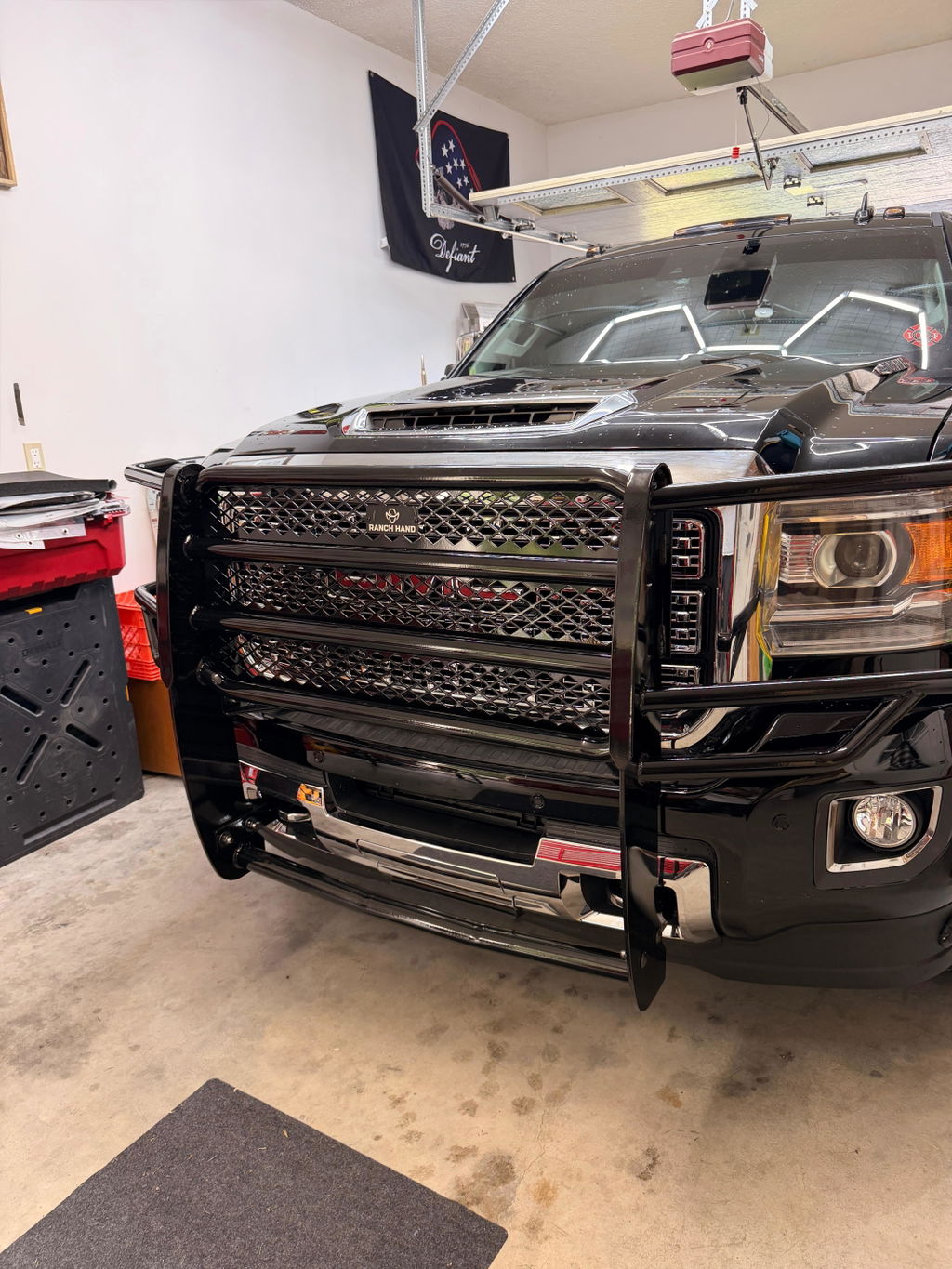
It has to be a bumper, not a guard. A grille guard bolts onto the factory bumper and leaves it there underneath, so the plastic and the mounts still take the hit. A replacement front bumper takes the factory bar off and bolts steel to the frame in its place. Both have hoops in the photo. Only one changes what is behind them, and the guard is about half the price. That is why it gets bought by mistake.
It has to be steel. Both brands list an aluminum version under the same series name. It is lighter, it costs more, and for this job it is the wrong buy.
The steel has to go up over the lights. A low front bumper, bullnose or not, sits about where the factory bar sat and looks the part, and on a truck buying the stance it is the right buy. But the headlights and the grille are open above it, and lights and cooling decide whether a truck drives home or leaves on a hook.


On a current Super Duty the ones that pass all 3 tests are the Steelcraft HD Replacement and the steel HD Elevation, and the full-height Ranch Hand Summit and Legend. Not the Bullnose versions of those 2, which carry the same series names for about $400 to $520 less. The band is $1,600 to $2,100 for the bumper, plus $300 to $600 to fit it, fall 2026, and Ranch Hand list prices go up on October 1. Other trucks price differently, so send us the model.
For scale: a square-on hit that takes out the whole factory front end on an F250 runs $3,943 to $4,066 in dealer parts alone, before labor. Shop labor runs about $86 an hour on the posted national average and $150 or more in a big city, so price yours off a local estimate, not off ours.
Questions We Get
How long is a work truck off the road after a front-end hit?
The shop works on it for 3 to 5 days. The truck is gone far longer: insurance rentals after a crash ran 15 days when the vehicle still drove and 22.4 days when it did not, in early 2026. The gap is the estimate, the insurer's approval, the parts, what the shop finds when it opens the front up, and the weekends.
How do I work out what a day of downtime costs my fleet?
Price the shuffle, not a lost day of revenue, because no fleet parks a crew for 3 weeks. Add the hours lost moving tools between trucks, the overtime to catch up, any rental, and the job you pushed. Insurance has its own formulas for this, but they vary by state and policy.
Is it worth putting a steel front bumper on every truck in the fleet?
Usually not. Pull last year's invoices, find the trucks that keep taking front-end damage, and start there. Leave the pavement truck that has never been hit.
Put Steel on the Ones That Earn It
Pick the brand your crews will standardize on, then pick the truck.
Ranch Hand bumpers Steelcraft bumpers
Or start from the truck. Ford F250/F350, Chevy Silverado 2500/3500, Ram 2500/3500, GMC Sierra 2500/3500, Ford F150.
Send us the year and model and we will tell you which configurations pass all 3 tests. Order for more than 1 truck and we keep the part numbers on file, so the next one is a phone call.